Originally written: 3/14/2012; last Web page update: 3/13/2020, referencing rEFInd 0.12.0
This Web page is provided free of charge and with no annoying outside ads; however, I did take time to prepare it, and Web hosting does cost money. If you find this Web page useful, please consider making a small donation to help keep this site up and running. Thanks!
| Donate $1.00 | Donate $2.50 | Donate $5.00 | Donate $10.00 | Donate $20.00 | Donate another value |
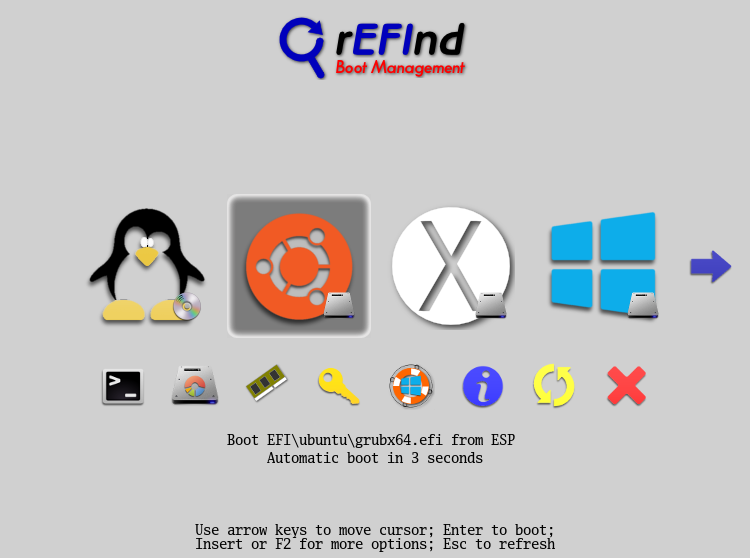
This page describes rEFInd, my fork of the rEFIt boot manager for computers based on the Extensible Firmware Interface (EFI) and Unified EFI (UEFI). Like rEFIt, rEFInd is a boot manager, meaning that it presents a menu of options to the user when the computer first starts up, as shown below. rEFInd is not a boot loader, which is a program that loads an OS kernel and hands off control to it. (Since version 3.3.0, the Linux kernel has included a built-in boot loader, though, so this distinction is rather artificial these days, at least for Linux.) Many popular boot managers, such as the Grand Unified Bootloader (GRUB), are also boot loaders, which can blur the distinction in many users' minds. All EFI-capable OSes include boot loaders, so this limitation isn't a problem. If you're using Linux, you should be aware that several EFI boot loaders are available, so choosing between them can be a challenge. In fact, the Linux kernel can function as an EFI boot loader for itself, which gives rEFInd characteristics similar to a boot loader for Linux. See my Web page on this topic for more information.
Reduces redundant memory allocation by overwriting expired dictionary nodes in place. 3. Hardware Vectorization (SIMD Support)
: In computer vision and video analysis, decomposing video into its constituent parts or features can be an area of research. This could involve separating a video into background and foreground, identifying specific objects or actions, etc.
[ Compressed Input Buffer ] │ ▼ ┌──────────────────────────────┐ │ Pre-Parsing & Validation │ ◄── Integrity Checks (CRC32/Adler32) └───────────┬──────────────────┘ │ ▼ ┌──────────────────────────────┐ │ xvodecompk Kernel Engine │ ◄── Bitstream Parsing & Huffman Decoding └───────────┬──────────────────┘ │ ▼ ┌──────────────────────────────┐ │ SIMD Vector Acceleration │ ◄── AVX-512 / ARM Neon Execution └───────────┬──────────────────┘ │ ▼ [ Uncompressed Output Stream ] 1. Bitstream Parsing Layer
: Clear your compilation cache and explicitly append the architecture directory flags ( -L/usr/local/lib/xvo/ ) during the final build phase. 2. Segment Fault During VRAM Handshake xvodecompk
Whether you choose the universal power of , the system-wide integration of the K-Lite Codec Pack , the mobile magic of MX Player , or the permanent fix of converting your video with HandBrake , you will never again be stopped by a "missing codec" error. Enjoy your videos, no matter how they were encoded.
Implements predictive branch-hinting to minimize CPU pipeline stalls during decompression. 2. The Dictionary Lookup Engine Employs an ultra-fast, sliding-window dictionary mechanism.
: If you meant a different tool or term, please check the spelling. Highly niche or proprietary This could involve separating a video into background
Modern computers are powerful and can often handle most codecs with the right software. However, . Their built-in media players are designed for maximum compatibility with modern, licensed formats like H.264 and H.265. They frequently lack a license for—or simply omit—the older Xvid codec. This is why a video might play perfectly on your PC but show a "Format not supported" error on your phone.
If you encounter problems, here are some common pitfalls and solutions.
In modern software development and data architecture, optimizing transmission speed and minimizing storage footprints are critical challenges. Behind the scenes of many high-performance systems sits —a specialized utility engineered for low-level byte-stream decompression, binary payload extraction, and legacy structural decoding. but they involve solving large
Implicit solvers (like those based on Backward Differentiation Formulas - BDF) are required, but they involve solving large, complex systems of non-linear equations at each step, making them computationally intensive.
Highly compressed video often suffers from pixelation. Decompression toolkits use advanced mathematical filters to smooth out blocks without losing sharp details.
copyright © 2012–2020 by Roderick W. Smith
This document is licensed under the terms of the GNU Free Documentation License (FDL), version 1.3.
If you have problems with or comments about this Web page, please e-mail me at Thanks.
Return to my main Web page.