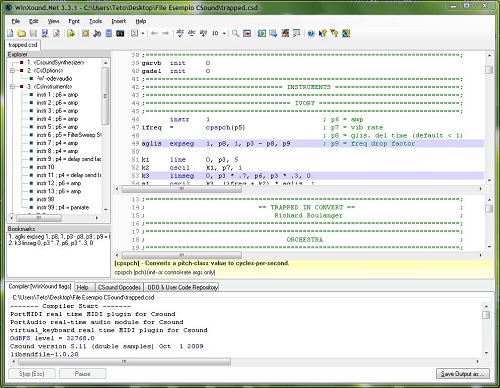
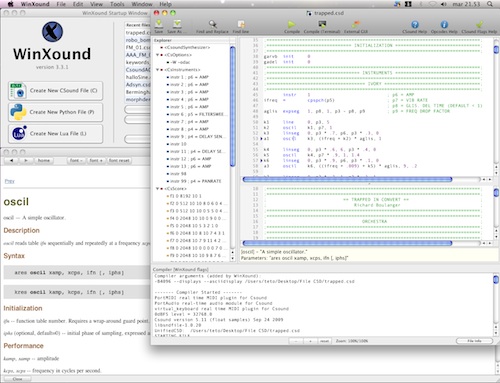
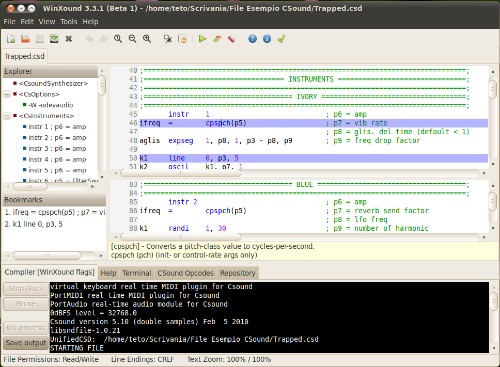
A free and open source editor for CSound with Python and Lua support.
About
WinXound is a free and open source Front-End GUI Editor for CSound, CSoundAV,
CSoundAC, with Python and Lua support, developed by Stefano Bonetti.
It runs on Microsoft Windows, Apple OsX and Linux.
WinXound Features:
Edit CSound, Python and Lua files (csd, orc, sco, py, lua) with Syntax Highlight and Rectangular selection;
Run CSound, CSoundAV, CSoundAC, Python and Lua compilers;
Run external language tools (QuteCsound, Idle, or other GUI Editors);
CSound analysis user friendly GUI;
Integrated CSound manual help;
Possibilities to set personal colors for the syntax highlighter;
Convert orc/sco to csd or csd to orc/sco;
Split code into two view horizontally or vertically;
CSound csd explorer (File structure for Tags and Instruments);
CSound Opcodes autocompletion menu;
Line numbers;
Text-area rectangular selection;
Bookmarks;
...and much more ... (Download it!)
Videos Myanmar Xxx 128x96 Low Quality3gp New -
By understanding the preferences and trends shaping the low entertainment content and popular media landscape in Myanmar, media companies and content providers can capitalize on the opportunities presented by this growing market.
The appetite for entertainment quickly moved toward high-bandwidth applications. Platforms like TikTok became massive cultural drivers for youth culture. Localized streaming applications also emerged to satisfy the demand for high-definition media, including:
The 128x96 Era: Low-Resolution Entertainment Under Isolation
: These ultra-small files could bypass the need for broadband, spreading through slower 2G/Edge cellular bands and peer-to-peer transfers. videos myanmar xxx 128x96 low quality3gp new
: A major online TV platform allowing millions to stream local broadcast content, international dramas, and live TV channels like MRTV-4. 3. Hyper-Local Digital Content: The 2D3D Subculture MOBILE MYANMAR - Save the Children
This feature is designed to be simple, easy to read, and informative, even at a low resolution of 128x96. The image and text elements are carefully balanced to provide a clear overview of Myanmar's low-key entertainment scene and popular media outlets.
: Small, vibrant images (128x96) often featuring popular actors or Buddhist iconography were some of the first forms of digital personalization for many citizens. Popular Media and the Shift to Social Platforms By understanding the preferences and trends shaping the
Yet, the enduring popularity of localized music, digital journals, and social media platforms shows an audience that remains determined to stay connected. They continue to share, stream, and create media through whatever digital means are available. Share public link
: The premier digital mobile cinema platform hosting a massive database of modern Burmese movies and dramas.
As infrastructure improved, "low entertainment" transitioned from low-resolution files to "low-barrier" content on social media. Today, the media landscape is dominated by a few key platforms: Localized streaming applications also emerged to satisfy the
This guide outlines the landscape of popular media and the practical application of low-resolution (128x96) content in as of early 2026. 1. Popular Media Landscape (April 2026)
The technical limitations of 128x96 media naturally influenced the type of content being produced and distributed. High-definition visual fidelity was replaced by high-concept, auditory, or dialogue-heavy entertainment that could survive aggressive compression. Short-Form Comedies and Skits
THE SOFTWARE IS PROVIDED "AS IS", WITHOUT WARRANTY OF ANY KIND, EXPRESS OR IMPLIED, INCLUDING BUT NOT LIMITED TO THE WARRANTIES OF MERCHANTABILITY, FITNESS FOR A PARTICULAR PURPOSE AND NONINFRINGEMENT. IN NO EVENT SHALL THE AUTHORS OR COPYRIGHT HOLDERS BE LIABLE FOR ANY CLAIM, DAMAGES OR OTHER LIABILITY, WHETHER IN AN ACTION OF CONTRACT, TORT OR OTHERWISE, ARISING FROM, OUT OF OR IN CONNECTION WITH THE SOFTWARE OR THE USE OR OTHER DEALINGS IN THE SOFTWARE.
Installation
Microsoft Windows
Download and install the latest version of CSound 5 (http://sourceforge.net/projects/csound);
Download the WinXound zipped file, decompress it where you want (see the note below), and double-click on "WinXound_Net" executable;
Note: WINXOUND FOLDER MUST BE LOCATED IN A PATH WHERE YOU HAVE FULL READ AND WRITE PERMISSION (for example in your User Personal folder).
Apple OsX
Download and install the latest version of CSound 5 (http://sourceforge.net/projects/csound);
Download the WinXound zipped file, decompress it and drag WinXound.app to your Applications folder (or where you want). Launch it from there.
Windows: The source code is written in C# using Microsoft Visual Studio C# Express Edition 2008
OsX: The source code is written in Cocoa and Objective-C using XCode 3.2 version
Linux: The source code is written in C++ (Gtkmm) using Anjuta
For the OsX-Cocoa version of WinXound special thanks go to Giuseppe Silvi for the debugging help and other useful suggestions.
The TextEditor is entirely based on the wonderful SCINTILLA text control by Neil Hodgson (http://www.scintilla.org).
Credits
Many thanks for suggestions and debugging help to Roberto Doati, Gabriel Maldonado, Mark Jamerson, Andreas Bergsland, Oeyvind Brandtsegg, Francesco Biasiol, Giorgio Klauer, Paolo Girol, Francesco Porta, Eric Dexter, Menno Knevel, Joseph Alford, Panos Katergiathis, James Mobberley, Fabio Macelloni, Giuseppe Silvi, Maurizio Goina, Andrés Cabrera, Peiman Khosravi, Rory Walsh, Luis Jure and Giovanni Doro.